Zinaida SHEVCHENKO,
local historian and community activist (Khmelyove, Kirovohrad region)
“OUR TASK IS TO DOCUMENT AND PRESERVE THE MEMORY OF A PAST THAT WAS FORBIDDEN DURING THE SOVIET REGIME”


I, Zinaida Fedorivna Shevchenko, live in the village of Khmelyove, formerly part of the Malovyskivskyi district, now the Novoukrainskyi district, in the Kirovohrad region.
Today in Khmelyove, a memorial plaque was unveiled in honor of Otaman Zalizniak, who had close ties with the Kholodnyi Yar otamans. His name was Yukhym Ivanovych Kovalenko. His portrait holds a place of honor in the new hall of our village museum. In the context of today’s war, the slogan under which Otaman Zalizniak’s detachment operated—"Ukraine without Communists! Down with the Katsaps!"—takes on new meaning, reinforcing our belief that this war is not a coincidence, but a historical inevitability.
Interestingly, the slogan wasn’t cited by the otaman himself, but by witnesses during the investigation who sought his punishment. These testimonies have been preserved by the Kirovohrad Archive—many thanks to them. We also have a list of the insurgents’ names, not provided by Zalizniak, but mentioned during the investigation by his own brother, Ivan Kovalenko.
The Kovalenko family, a peasant family, had three brothers: Yukhym, Ivan, and a third, who served as a priest in the neighboring village of Hlodosy. All three received a decent education and held respected positions in their rural communities—Hlodosy and our own Khmelyove. All three were swallowed by the maw of communist repression.
I want to say a separate word about Ivan, who, like Yukhym, was a teacher. From the very beginning, Ivan sided with the Bolsheviks—that was his worldview and stance. In 1921, shortly after the anti-Soviet sentiments in our region had been suppressed, Ivan was arrested and executed solely because he was Zalizniak’s brother. I assume that a similar fate befell Father Kovalenko, the second brother.
In the list of rebels you’ll find names like Hetmantsi, Zaporozhtsi, Kompaniytsi, Porokhy, Babychi… I myself am not originally from this village. When we moved here, we dreamed of owning our own home. We bought a house, and right in front of it stood a tiny, very old cottage, where an elderly woman lived—kind, deeply religious, with a proud gaze. It turned out that this cottage, which no longer exists, had once housed the headquarters of Zalizniak’s fighters, and the man who built it, Fedir Chovpan, was the commander of that headquarters. His daughter and grandson have passed away, but his granddaughter Lyudmyla is still alive.
Zalizniak was executed in 1929, and Fedir Chovpan in 1937. His daughter was born after his death, in 1938. On the neighboring street lived Fedir’s brother, Hnat Chovpan, who from the very beginning supported the Bolsheviks. In his memoirs about the Bolshevization of the region, Hnat does not mention his brother—neither in a good nor a bad light. The same goes for Ivan Kovalenko: when giving testimony to the prosecutor’s office, fully aware that he would be executed, he never said a bad word about his brother. These were highly moral, devout people, for whom family ties and values meant a great deal.
The Soviet-era postulate about a fratricidal civil war is one of the ideological constructs that distorted our perception of those events. According to this narrative, the rebels and anti-Soviet resistance fighters were bandits, while Budyonny—who slaughtered the local population here because they wanted to build life in their village with their own hands—and Kotovsky, a repeat offender with a 15-year prison record, were hailed as heroes. For decades, the ideological machine instilled such twisted ideas into Ukrainians.
So, when we set out to revive the museum and create this new hall, our conceptual aim was this: to honor those whose names were erased or desecrated by Soviet ideology.
Let us stop here at this portrait. This is a teacher, like Zalizniak—a village boy from a peasant family. In the late 1930s, Pavlo Tymofiyovych Zaporozhets, having completed his studies at the Odesa Art School, returned to his village and began teaching drawing and other subjects at the local school.
In 1941, the German occupation began. The first thing the people of Khmelyove did was appeal to the occupation authorities: "Open the church!" One woman, Sofia Lysenko, asked for her house back—the same house she and her children had been evicted from during collectivization. It was returned.
The Soviet authorities had stripped the church’s iconostasis of its gilding because they needed gold, and the church had been closed. From our window you can clearly see the church—it’s 200 years old. When the doors were reopened in 1941 and people saw that the iconostasis was gone, they didn’t enter. According to church tradition, a church without an iconostasis is considered dead.
At the time, there were two artists in the village: Pavlo Tymofiyovych Zaporozhets and Ivan Lysenko, the son of Sofia Lysenko. The villagers asked them to create a new iconostasis. It was a monumental and difficult task, but the artists fulfilled the community’s request.
After the war, Pavlo Tymofiyovych Zaporozhets was accused of collaborating with the occupation authorities and sentenced to 12 years in exile. He returned a bit earlier, after Stalin’s death, very ill but morally unbroken. Here is a photo of him taken after his return.
Until the end of his life, he refused to let his wife join the kolkhoz. They lived in great poverty, but he would not work for the Soviet regime. He earned a living through embroidery, producing an enormous number of works—towels and entire tapestries.
Once, a neighbor asked him to embroider a portrait of Lenin. I don’t know how he found the courage—perhaps he simply didn’t want to refuse his closest neighbor. That portrait still exists and is displayed in our museum.
We also have works by Ivan Lysenko, the second artist who helped create the iconostasis in our church. He lived in Russia, in Rostov, and worked all his life as an artist in an art studio.


THE COMMUNARDS WERE FED,
WHILE IN THE NEIGHBORING VILLAGE PEOPLE DIED OF HUNGER
The anti-Soviet resistance in Ukraine was incredibly strong—and it wasn’t only armed resistance. Very often, it was quiet, unspoken. Not far from here is the village of Manuylivka, and beside it was a small hamlet called Novokostiantynivka, where a woman lived who, during a village assembly, tried to persuade people not to join the kolkhoz (I read her criminal case file). She urged: “People, don’t join the kolkhoz. Take back what was taken from you—your horses, your cattle. Save your property. If we don’t do this, there will be famine.”
She was arrested and thrown in prison, but some people filed an appeal and—miraculously—managed to get her released. She survived.
So yes, many people understood what Bolshevization and Sovietization would mean for Ukraine. One didn’t have to be a prophet to see that scoundrels had arrived. There was hunger in 1921, too, but what happened after collectivization in 1932–33 was incomparably worse. When my husband, Vasyl Ivanovych, and I came to Khmelove, there were still survivors of that tragedy. We don’t have any family buried in our village cemetery, but I visit the graves of those who shared their stories with me.
The communists implemented several forms of collectivization: there were kolkhozes, sovkhozes, and also communes. The distinct feature of a commune was that people not only worked collectively but also ate collectively. Children were handed over to the state to be raised.
One woman from a nearby village worked at the commune’s bakery in 1933. In Novohryhorivka, there was no famine because the commune administration was obligated to feed its members daily. But in Khmelyove, just across the bridge, people were dying of starvation.
One day, starving children from Khmelyove came to her, begging for bread. She couldn’t refuse—they were all familiar faces. One day she gave a slice, the next day half a loaf… And on one occasion, she gave away all nine loaves she had just taken from the oven. She baked more for the commune members by the evening.
The next day, a party official from Khmelyove, which at the time was the district center, came to prosecute Yelyzaveta Kindrativna Zaporozhets for misappropriation of property. But the people of Novohryhorivka were incredible—so kind, unlike us Khmelyove villagers, I don’t know why. The entire commune gathered and defended Yelyzaveta Kindrativna. She was never tried and lived a long life—over 90 years. I’m grateful to fate for bringing me together with this woman.
Communes survived because the grain allocated for feeding their members was excluded from their grain delivery quotas. In contrast, in Khmelyove, they were forced to surrender everything—even the last handful of beans from private households.
During the 1932 grain procurement campaign, winter came unusually early. Snow fell, and they didn’t have time to transport the harvest out of Khmelyove. Near the center of the village stood the “holubinky”—long storage buildings for grain. They were guarded day and night with weapons. Even as entire families were dying of hunger, the local authorities didn’t care. Their only concern was fulfilling the grain delivery plan by any means necessary.
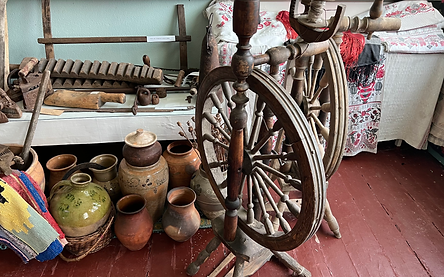
We have a millstone in our museum exhibition. I’ve often heard that people hid or smashed them—if a grain requisition squad found a millstone, it was seen as a sign that grain was being concealed. In Khmelyove, people even bricked them into walls—creating secret compartments to hide them.
In secret, they would grind a handful of beans, or whatever grain they could find—dry grass, acorns, tree bark. I’ve done research on what people ate and how they tried to survive starvation.
Here’s another artifact—it belonged to the Sopiluk family, one of the oldest in Khmelyove, listed among the founders of our settlement. I found this handwoven cloth on the stove-bed of elderly Vira Prokopivna, who told me her parents were among the first to join the kolkhoz. Just before collectivization, her grandfather had built a new house for her father. To avoid being labeled as "kulaks," they agreed to dismantle the house and donate the materials to the commune for agricultural buildings. They themselves moved to the commune in Novohryhorivka.
During the famine years, people came to the commune hoping to barter for food. One woman brought a bright woolen shawl. Kateryna Hetmanets, Vira’s mother, gave her a glass of millet in exchange.
Another heartbreaking story was told to me by a woman who moved near the school about twenty years ago, where I worked all my life. We became acquainted.
One day she brought a family heirloom to the museum. In the spring of 1933, her little brother Veniamin died from a severe illness, exhausted by hunger. There was nothing in the house—only a towel hanging by the icons. They took it down, cut off the embroidered part, and wrapped the child’s body in the remaining plain cloth for burial.
This woman kept the embroidered fragments, restored the towel after her parents passed away, and donated it to our museum.
I could tell many more tragic stories about my fellow villagers.
A year ago, I was traveling by train and started talking to the woman sitting next to me. When she learned I was from Khmelyove, she lit up and told me about her family. Her mother had been orphaned in 1921—perhaps due to that year’s famine.
In Khmelyove lived her uncle, Ivan Chornyi (in the 18th century, our region was settled by foreigners—Serbs, Bulgarians, Vlachs—and Ivan came from a Serbian lineage).
One day, at the market by the church, Ivan saw his sister’s widowed husband. The man looked sullen and didn’t even want to acknowledge him. But Ivan called out, asked how things were. When he heard that three of his nieces and nephews had already died of starvation, he offered to take one of the two surviving girls.
That girl, Polinka, came to live with her uncle in Khmelyove in 1933 and survived thanks to her family. She finished school here, became a teacher, and spent her life teaching math in the nearby village of Kozakova Balka.
When our renowned fellow countryman Volodymyr Brovchenko’s book "Viknyna"[1], was published, I was intrigued by the word itself.
It turns out that viknyna doesn’t just mean a spring, but a “breathing” spring—a source of water that doesn’t freeze in winter because it “breathes” with the warmth of the earth.
One day, I heard this old word used by a woman who told me the story of her mother-in-law. I only remember her surname—Tkach. It was the late 1940s, when a decree was issued punishing those who failed to complete the minimum number of mandatory labor days (trudodni)[2]. According to that decree, every resident—including children as young as 12—had to work a set number of days in the kolkhoz. The quota for children was 50 days a year; for adults, over 200. Those who failed to meet the quota were subject to imprisonment and exile.
One day, local officials arrived at the home of a woman with three children. Terrified—because her neighbor had just been arrested for the same reason—she grabbed her children and ran to the riverbank to hide in the reeds. But that area was full of viknyny—warm water springs—or deep mud that could swallow you whole. She knew the hidden paths well, and she hid with her children among the reeds for over a day. But when she emerged, she had gone mad. Her mind never recovered, and she spent the rest of her life in a psychiatric institution.
Yet her children never abandoned her. They loved her deeply and would bring her back to their native village from time to time, so she could spend time with them and her grandchildren. Every time she stepped into the yard, a cry would burst from her chest: “Children, let’s run and hide!”
You see how everything is connected—the current war and Zalizniak’s uprising over a century ago. The pages of history keep gaining new relevance. Without a doubt, the human factor in preserving the past plays a vital role.
My husband and I underwent a kind of self-nationalization long ago, back in our student days. We were fortunate to have excellent professors who taught us to think critically, to search for the truth in historical facts. As long as we had the strength and were professionally active, we did our best to share with our students a truthful, genuine, Ukrainian version of the past—not the one distorted by Soviet ideology.
Today, there is plenty of historical literature that allows Ukrainian history to be taught in a new light. But when we started, all we had was a single copy of Orest Subtelny’s book—probably the only one in the entire district.
In Kirovohrad region, there is a remarkably strong group of historians and researchers of the past—among them Vasyl Vasylovych Bondar, his wife Svitlana Orel, and Ivan Danylovych Petrenko.
Our village once had two schools: a parochial church school and a zemstvo school. Until recently, the zemstvo school still functioned as a nine-year school. Back in the day, it employed a husband-and-wife teaching couple, the Patyutkos, who took part in the anti-Bolshevik uprising and were executed by Soviet authorities. But not only those who were repressed suffered—their children did, too.
I’ve already mentioned that next to our house once stood the home of the Zalizniak headquarters commander. His daughter lived there until her death. A gloomy, withdrawn woman who carried a deep pain within. We hardly ever spoke. But once I learned who her father was, I approached her, shared what I knew, and thanked her. He had already been officially rehabilitated, but she had no idea.
Another man, from the Pylyshchyk family—also one of the founding families of our village—told me: his father had been arrested and imprisoned, and he himself bore the mark of “enemy of the people’s son” for many years. In fourth grade, all the children were made Young Pioneers and given red neckerchiefs—but not him. He cried...
As for our museum, we are facing a huge problem. After the recent administrative reform, our institution was not registered under the new administration of the Smoline Hromada. In other words, we are not officially recognized—we don’t exist on paper.
But what gives me hope is that so many people are involved in this volunteer effort: my family, my husband’s family, the families of fellow villagers, patrons, volunteers—people who came together to support the idea of documenting and preserving the memory of a past that had been silenced and forbidden under Soviet rule.
[1] Volodymyr Yakovych Brovchenko (1931–2013) was a Ukrainian poet and public figure. His last book, Viknyna (2005), is a memoir covering the period from the 1930s to the beginning of the 21st century.
[2] Trudoden (literally "labor-day") was a term related to the form of labor compensation in Soviet collective farms (kolkhozes), introduced in 1930–31 during the forced collectivization of agriculture.
On February 21, 1948, the Presidium of the Supreme Soviet of the USSR issued a decree stating that anyone who failed to fulfill the established minimum number of trudodni could be forcibly resettled outside Ukraine. Criminal liability was also imposed for not meeting the minimum labor quota.
By a resolution of the Central Committee of the Communist Party of the Soviet Union and the Council of Ministers dated May 15, 1966, titled “On Increasing the Material Incentives for Kolkhoz Workers in the Development of Collective Production”, kolkhozes were recommended to replace the trudoden system with guaranteed monetary compensation. As a result, the trudoden system was phased out.